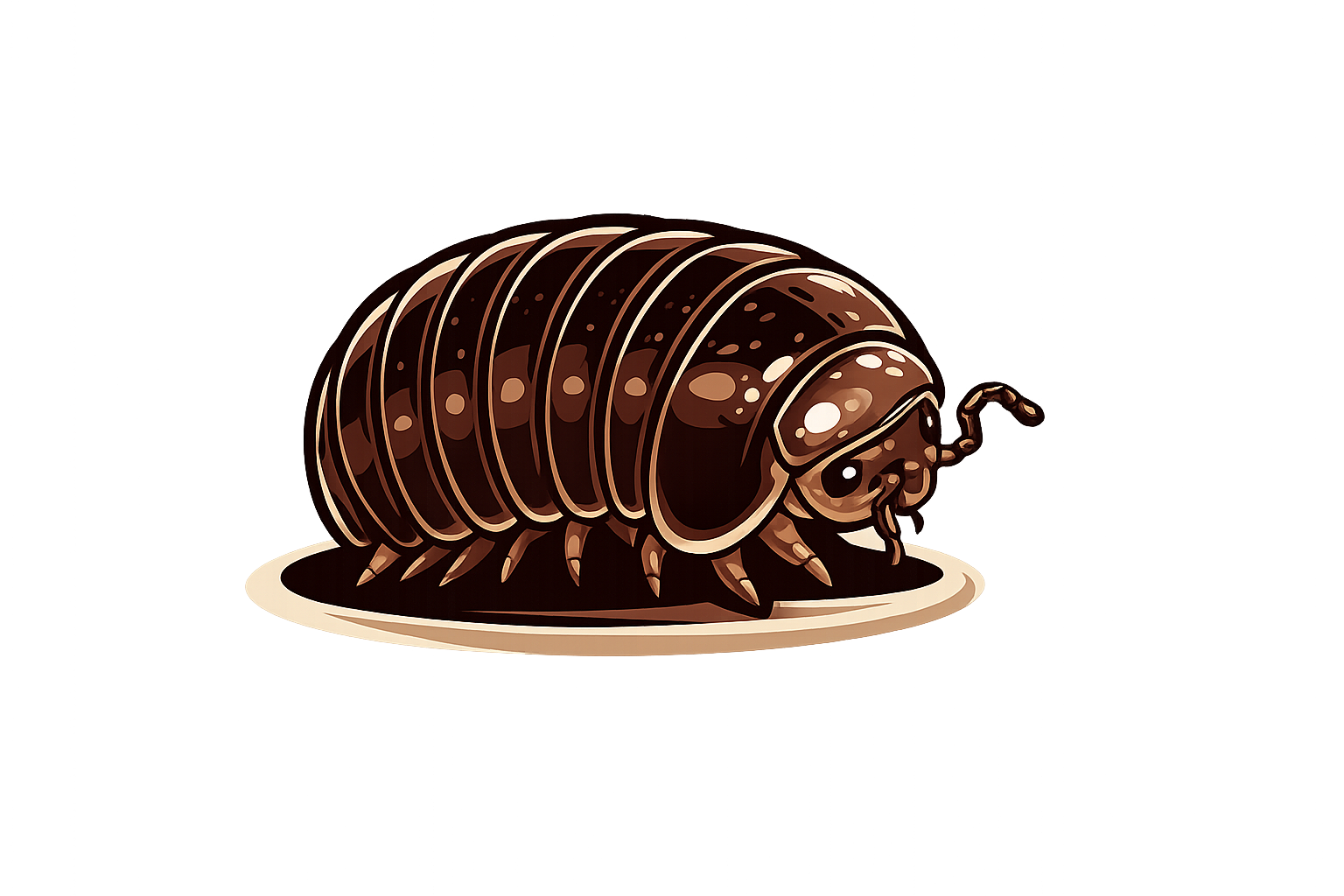
Order · Diplopoda · Pentazonia
CLICK TO ROLL

Giant Pill
Millipedes

The living spheres of the ancient Gondwanan forest

0Described Species
0Genera
0Million Yrs of Evolution
0Tergite Plates
Scroll

Phylogeny &
Gondwanan Biogeography

Sphaerotheriida exhibits a strict Gondwanan distribution—a perfect biogeographic mirror of tectonic fragmentation between 160 and 90 million years ago. Their poor dispersal capabilities mean their modern range is a living fossil record of an ancient supercontinent.

Notably absent from South America and Antarctica, the order is divided into five extant families spanning southern Africa, Madagascar, India, Southeast Asia, and Australasia.

The Five Families

  • ProcyliosomatidaeAustralia · NZ
    The most basal family, resolved as the sister group to all other Sphaerotheriida. Strictly endemic to Australia and New Zealand, representing the deepest split in the order's phylogenetic tree.
  • CyliosomatidaeAustralia
    Found across Australia alongside the more basal Procyliosomatidae. Shares the Australian continent with its phylogenetic relatives, reflecting the ancient Gondwanan origins of the order.
  • ZephroniidaeSE Asia · Himalayas
    The only family extending into the Northern Hemisphere. Distributed across Southeast Asia from the Himalayan foothills to the Philippines and Sulawesi—the result of the Indian subcontinent's collision with Laurasia carrying ancestral lineages northward.
  • SphaerotheriidaeSouthern Africa
    Endemic to southern Africa, primarily South Africa with isolated populations in Zimbabwe and Malawi. These are some of the most morphologically distinctive giant pill millipedes, with robust, heavily calcified exoskeletons.
  • ArthrosphaeridaeIndia · Madagascar
    A monophyletic clade bridging southern India and Madagascar—reflecting the ancient direct land connection before rifting. Includes spectacular island gigantism (Zoosphaerium, baseball-sized) and localized island dwarfism (Microsphaerotherium).

Gondwanan Distribution

AUSTRALIA SE ASIA S. AFRICA INDIA MDG Former Gondwana fragments
Procyliosomatidae + Cyliosomatidae
Zephroniidae
Sphaerotheriidae
Arthrosphaeridae

Gross Morphology
& Anatomy

Built like a fortress, the sphaerotheriidan body is a masterclass in defensive architecture. Every anatomical feature—from the calcified tergites to the modified male appendages—serves the twin imperatives of survival and reproduction.

🛡
13 Tergite Plates
A dwarfed collum, an enlarged thoracic shield, 10 body tergites, and a massive fused anal shield. The cuticle is heavily calcified—lacking the chemical defense glands (ozopores) found in almost all other millipede orders.
Exoskeleton
🦵
Sexual Leg Dimorphism
Females possess exactly 21 pairs of walking legs. Males carry 23 pairs—but the terminal two pairs are radically modified into specialized sexual organs called telopods, used in mating.
Appendages
👁
Sensory Apparatus
Short antennae, large compound eyes, and the Organ of Tömösváry—a specialized sensory structure associated with humidity detection and chemoreception, unique among arthropods.
Sensory
⚗️
No Chemical Defense
Unlike nearly all other millipede orders that rely on ozopores to release toxic or repellent chemicals, Sphaerotheriida abandoned this entirely—betting everything on mechanical armor instead.
Defense Strategy
🔮
Calcified Cuticle
The exoskeleton is impregnated with calcium salts, creating a shell of near-ceramic hardness. Growth rings on tergites can be read like tree rings, revealing lifespans exceeding a decade.
Material Science
🔬
Locking Carinae
Sclerotized ledges on tergite undersides that slide over a brim on the thoracic shield when conglobated—functionally locking the sphere shut. The mechanism is so effective it resists avian and mammalian predators.
Interlocking Mechanism

The Art of
Volvation

Volvation—the ability to enroll into a perfect, impenetrable sphere—is the defining behavior of Sphaerotheriida. More derived and structurally complete than the similar behavior seen in pill bugs or northern pill millipedes, it represents millions of years of evolutionary refinement.

01

Threat Detected

Any disturbance triggers the response instantly. The animal reflexively tucks legs inward and begins curling the posterior segments.

02

Posterior Enrollment

The anal shield swings forward and downward. Tergites 3–12 begin folding inward, their depressed anterior margins preparing to engage the thoracic shield groove.

03

Tergite Interlocking

The tips of tergites 3–12 fit seamlessly into a specialized groove on the thoracic shield—like tumblers in a lock clicking into place.

04

Sphere Locked

Locking carinae slide over the thoracic shield brim, securing the sphere. Even determined predators cannot pry it open. The animal may remain locked for hours.

EXTENDED BEGINNING CURL HALF ENROLLED LOCKED SPHERE ✓ Carinae engaged

Ecology &
Forest Role

🍂 Detritivore Diet

Giant pill millipedes are keystone detritivores, feeding on decaying leaf litter and dead wood. Their specialized hindgut microbiota—analogous to that found in termites—enables breakdown of highly refractory compounds like lignin and cellulose that most animals cannot digest.

0mg/day defecation rate
10+yr estimated lifespan

🌱 Nutrient Cycling

With defecation rates reaching 350–470 mg per individual per day, these millipedes are essential humification engines. They physically fragment litter and disperse mycorrhizal fungal spores through their castings, accelerating decomposition and soil formation across their forest habitats.

13Tergite growth rings
Mycorrhizal dispersal

🌳 Arboreal Specialists

While predominantly ground-dwelling, select species such as Zoosphaerium arborealis have adopted a tree-climbing, arboreal lifestyle in highly humid rainforests. Fascinatingly, in these canopy species, the rolling reflex is often behaviorally suppressed—rolling up at height would mean a fatal fall to the forest floor.

🐛 Metachronal Movement

Locomotion proceeds via a slow, elegant metachronal wave—a sequential stepping pattern traveling from posterior to anterior. The hundreds of legs move in rippling coordination, giving the animals their characteristic flowing movement across the forest floor.

Molting during dry seasons requires weeks of immobility.

Reproductive Biology
& Stridulation

Reproduction relies on an extraordinary combination of acoustic signaling, indirect sperm transfer, and physical grappling. Because females reflexively conglobate at any disturbance, males must literally sing them into unrolling before mating can begin.

🎵 The Harp & Washboard

Males possess a stridulatory organ on their anterior telopods called a "harp"—sclerotized ribs that rub against knobs on the anal shield. Females possess complementary ridges on their subanal plate, the "washboard." The resulting vibrations are species-specific.

Simulated species-specific vibrational signal

Mating Sequence

Female Conglobates

Any approach causes the female to roll into a locked sphere. The male must work around this impenetrable defense.

Male Stridulates

The male approaches and rubs his "harp" against anal shield knobs, transmitting species-specific vibrational frequencies directly through the ground.

Female Recognition

Upon recognizing the correct species-specific signal, the female uncoils—an act of consent encoded in vibrational frequency.

Posterior Telopods Engage

The male's massive pincer-like posterior telopods firmly clasp the female's first legs, securing their position.

Spermatophore Transfer

A spermatophore is ejected from penes located behind the male's 2nd leg pair and passed backward by legs into the female's vulvae—an elaborate indirect transfer.

Conservation &
Vulnerability

Despite their seemingly impenetrable armor, Sphaerotheriida are deeply fragile in the face of anthropogenic change. Their specialized requirements, poor dispersal, and slow reproduction make them highly susceptible to habitat disruption.

🌲
Deforestation
Slash-and-burn agriculture and logging destroy the moist forest habitats these animals depend on. In Madagascar, many species are confined to rapidly shrinking forest fragments.
💊
Traditional Medicine Trade
In South Africa, significant collection pressure exists from the traditional medicine trade. Their large, impressive size and armor make them conspicuous—and vulnerable—targets.
🏔
Micro-Endemism
Poor dispersal abilities and strict humidity requirements mean many species are restricted to single karstic hills or isolated rainforest fragments—with no ability to recolonize after local extinction.
🌡
Climate Sensitivity
As obligate humidity specialists, even modest changes in rainfall or temperature can extirpate isolated populations. Their inability to disperse means climate refugia must exist within existing ranges.
🔬
Taxonomic Discovery
Many species almost certainly remain undescribed. Active taxonomic research in Madagascar and Southeast Asia continues to reveal new species—some likely already endangered before being formally named.
📡
Biogeographic Sentinel
Their strict fidelity to Gondwanan vicariance makes Sphaerotheriida ideal bioindicators of ancient forest continuity—their presence signals intact, undisturbed primary forest ecosystems.

"Despite their armored appearance, these ancient arthropods are among the most vulnerable denizens of the world's threatened forests—slow-reproducing, highly localized, and utterly dependent on the humid, complex habitats that humans are destroying fastest."