Order · Diplopoda · Pentazonia · Oniscomorpha
Extinct · Pennsylvanian–Permian
CLICK TO ROLL — SPIKY FORM SPIKY DEFENSIVE SPHERE ✦ Unlike any modern pill millipede

Order
Amynilyspedida

Carboniferous coal-swamp architects — 305 million years in the making

0Million Years Ago
14–15Body Tergites
0mm Max Length
0Leg Pairs
0Genera Known
Scroll

Paleontology &
Stratigraphic Distribution

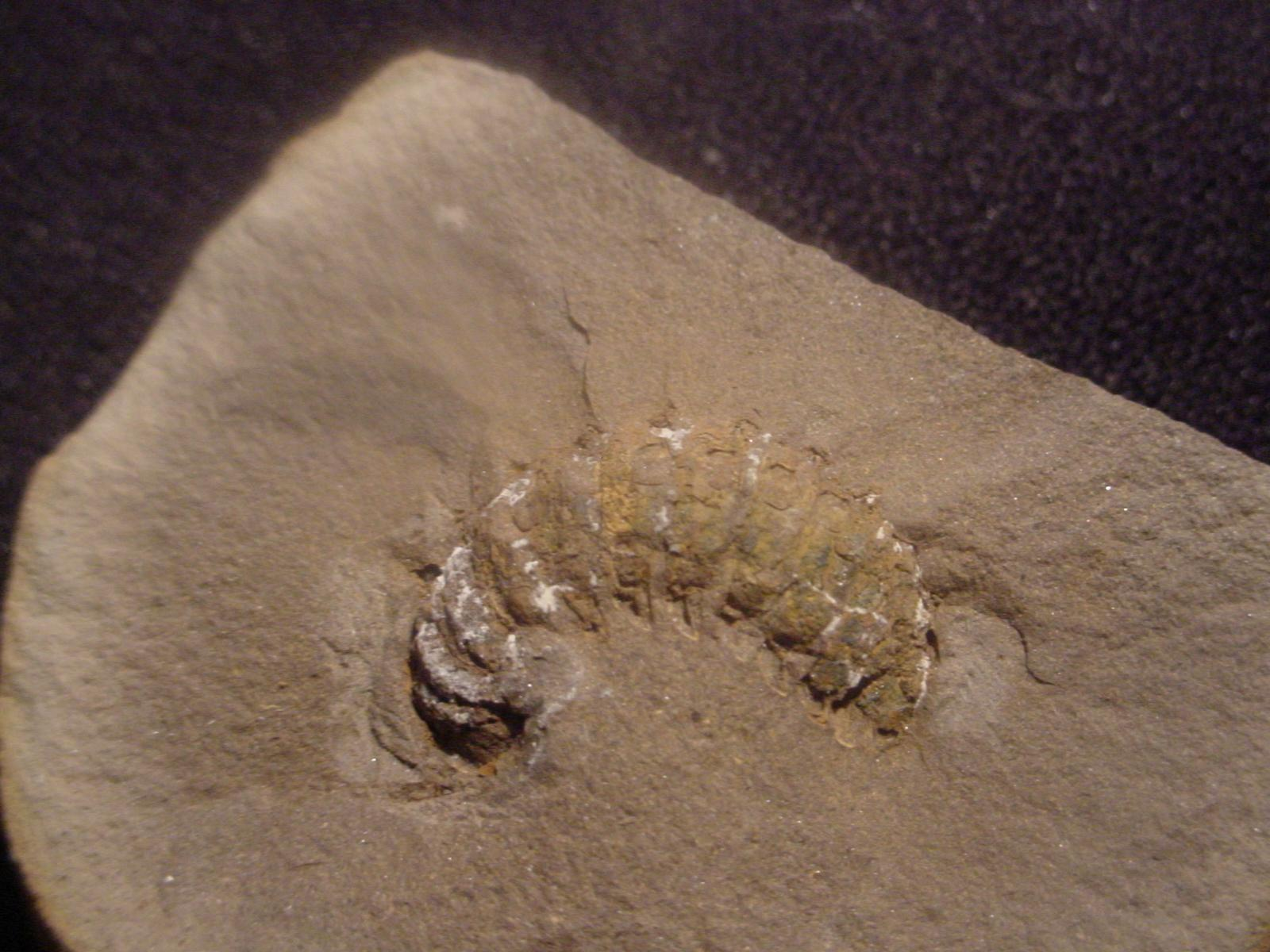
Our entire understanding of Amynilyspedida rests on fossils recovered from Upper Carboniferous Lagerstätten — fossil sites with extraordinary preservation. These are predominantly sideritic (ironstone) concretions from ancient coal swamp deposits: split open, they reveal the three-dimensional body of an arthropod dead for over 300 million years, sometimes in such detail that individual spines and eye facets are distinguishable.

Modern Analysis — X-Ray Microtomography (µCT Scanning)

Simulated µCT cross-section scan — ironstone nodule preservation

Major Fossil Sites

Mazon Creek
Illinois, USA · Pennsylvanian · ~307 Ma
The type site. Amynilyspes wortheni (described by S.H. Scudder, 1882) is the most commonly recovered oniscomorph from both the Braidwood (non-marine) and Essex (marine/estuarine) biotas. Ironstone nodules split to reveal exquisitely 3D-preserved specimens in both enrolled and extended postures.Type Locality
Montceau-les-Mines
Burgundy, France · Stephanian · ~305 Ma
A Kasimovian Lagerstätte yielding the recently described A. fatimae — analyzed using high-resolution X-ray µCT scanning, producing the first complete 3D anatomical reconstruction of an amynilyspedidan, including internal leg anatomy and posterior telopods.µCT Research Site
Nýřany · Saarland
Czech Republic · Germany · Westphalian D / Stephanian B
Czech and German sites yield species including A. typicus and A. crescens, demonstrating the order's widespread circum-equatorial distribution across the ancient tropical coal forests of Pangea/Laurasia — from North America to central Europe.Circum-Equatorial Range

Distribution on Late Carboniferous Pangea

CARBONIFEROUS COAL FOREST BELT Mazon Creek Montceau Nýřany Saarland Tethys Sea LAURUSSIA GONDWANA ~305 Ma — Late Carboniferous Pangea configuration

"The Mazon Creek ironstone nodules are time capsules — split one open and you hold a living coal-swamp in your hands, preserved in perfect fidelity for 307 million years."

Fossil Distribution
& Laurussian Range

u2020Amynilyspedida fossils are known exclusively from Euramerican deposits u2014 the ancient supercontinent of Laurussia. The finest specimens come from Mazon Creek (Illinois) and Montceau-les-Mines (France).

Known Fossil Sites

u2020Amynilyspedida fossil sites

Gross Morphology &
Transitional Anatomy

Amynilyspedida occupies a critical anatomical position between the generalized ancestral millipede body plan and the highly derived modern pill millipedes. Every key feature — the higher segment count, the prominent spines, the large compound eyes — is a plesiomorphic (ancestral) trait that modern orders subsequently lost or transformed.

Amynilyspedida
Carboniferous · Extinct
14–15
Ancestral count
Glomerida
Extant · Northern
11–12
Reduced & fused
Sphaerotheriida
Extant · Southern
13
Fixed at 13
👁
Large Compound Eyes
The most visually striking difference from modern pill millipedes: Amynilyspedida possessed highly developed, faceted compound eyes — suggesting active, visually-guided surface behavior in the Carboniferous forest. Modern glomeridans retain only single-row ocelli; Sphaerotheriida have large compound eyes, suggesting a partial ancestral retention.
Key Plesiomorphy
🦔
Prominent Dorsal Spines
The defining ornamentation: stout medial spines flanked by shorter lateral tubercles on each tergite. Modern oniscomorphs are completely smooth — the loss of spines in both lineages is a derived condition. µCT scans confirm that spines were solid calcified projections, not hollow.
Diagnostic Character
🦵
21 Walking Leg Pairs
µCT reconstructions of A. fatimae confirm exactly 21 pairs of walking legs — identical to modern female Sphaerotheriida. The preservation of this ancestral count in a Carboniferous form reveals that leg pair numbers were already stabilized in the pentazonian ground plan over 300 million years ago.
Anatomical Count
📏
Up to 30 mm Body Length
Moderately sized by Carboniferous arthropod standards. While giant insects of the era (e.g., Meganeura dragonflies) exploited high-oxygen atmospheres, amynilyspedidans occupied a modest ecological niche as leaf-litter processors — a role echoed by their modern descendants.
Morphometrics
🛡
Smaller Anal Shield
The pygidium (anal shield) was relatively smaller and less derived than the massive, locking plate of modern Sphaerotheriida. This anatomical constraint limited the tightness of their spherical seal — compensated for by dorsal spines rather than smooth mechanical interlocking.
Exoskeleton
⚙️
Ironstone Preservation
Preservation in sideritic (iron carbonate) concretions formed rapidly around organisms shortly after death, before decay. The resulting 3D compression fossils capture even delicate anatomy. Modern µCT scanning extracts internal structure invisible to the naked eye — a revolution in Carboniferous myriapod study.
Taphonomy

The Spiny Sphere
& Biomechanics of Volvation

Amynilyspedida proved that conglobation — the ability to roll into a perfect sphere — predates the modern smooth pill millipede body plan by over 300 million years. But their volvation produced something entirely unlike the marble-like sphere of their descendants: an armored, spiky ball, functionally analogous to a hedgehog or spiny armadillo.

Extended — Active Surface Forager

Unlike modern pill millipedes, the large compound eyes suggest amynilyspedidans were active surface-dwellers in open or semi-open Carboniferous forest. Dorsal spines are fully erect, pointing upward in their natural resting orientation.

★ Visual predator-detection: large compound eyes active

Threat Detected — Rapid Curl

Longitudinal muscles contract simultaneously across all 14–15 tergites. The smaller pygidium begins rotating inward. Unlike modern forms with 11–13 segments, the extra tergites create a more gradual curvature during enrollment.

Half-Enrolled — Spines Reorienting

As the body curves, dorsal spines that pointed upward now project outward laterally and forward — creating a progressively bristling surface that actively discourages bite-attempts even during the transition phase.

★ Spines active during enrollment — unlike smooth modern forms

Complete Sphere — Spiky Ball

The enrolled form projects spines radially in all directions — a very different defensive geometry than modern smooth or locking-carinae forms. Functionally convergent with modern hedgehogs, pangolins, and spiny armadillos. Carboniferous predators (tetrapods, arachnids, large arthropods) would have faced a formidable, spike-studded obstacle.

★ No locking carinae — supplemented by spine deterrence
EXTENDED · SPINES ERECT CURLING — SPINES PIVOTING HALF ENROLLED · SPINES SPLAYING SPIKY SPHERE ✦ Armored like no modern descendant

Ancient vs. Modern Defensive Sphere

Amynilyspedida

305 Ma · Extinct

Enrolled into a sphere with protruding dorsal spines projecting radially — a hedgehog-like armored ball. The smaller, less-derived anal shield could not produce the airtight seal of modern forms. Defense supplemented entirely by passive mechanical spine deterrence.

Spiny surfaceNo locking carinae14–15 tergitesLarge compound eyes

Modern Oniscomorpha

Present · Extant

The smooth, impenetrable marble — either with mechanical locking carinae (Sphaerotheriida's ceramic-hard calcified seal) or chemical alkaloid coating (Glomerida's glomerin). Both strategies require the smooth, seamless sphere geometry that spines would prevent.

Smooth surfaceLocking carinae / Alkaloids11–13 tergitesSimple / compound eyes

Paleoecology &
The Carboniferous World

Amynilyspedidans thrived in the tropical coal-swamp forests of the late Carboniferous — a world of towering lycopsid trees (Lepidodendron, Sigillaria), giant tree ferns, and an oxygen-rich atmosphere that supported arthropod gigantism. This was a world 50 million years before the first dinosaur, and the ecological role these millipedes played was already the same as their modern descendants.

🌿
Detritivore Niche
Labrum and mandible structure, combined with their consistent association with fossilized fern fronds (Pecopteris) in the same ironstone nodules, confirms they fed heavily on decaying plant litter. The ecological role of a forest-floor detritivore was thus established in Oniscomorpha before the Permian — and has not changed since.
Feeding Ecology
🌳
Open-Habitat or Arboreal?
The large compound eyes and prominent defensive spines imply amynilyspedidans inhabited more exposed environments than their photophobic modern relatives. Some paleoecologists theorize they may have been semi-arboreal — climbing the massive, bark-scaled lycopsid trees of Carboniferous forests, where spines would aid grip and deter tree-climbing predators.
Habitat Theory
🦎
Carboniferous Predators
Their defensive spines likely evolved in response to the formidable suite of Carboniferous predators: early tetrapods (stem amphibians, stem reptiles), giant predatory arthropods (eurypterids, large myriapods), and early arachnids — none of which bear any relationship to the vertebrate predators that shaped modern pill millipede defenses.
Predator Pressure
🌬
High-Oxygen Carboniferous
The late Carboniferous atmosphere reached ~35% O₂ (vs 21% today), enabling arthropod gigantism across the ecosystem. Amynilyspedidans, though not gigantic, benefited from this high-oxygen world for active metabolism — enabling their hypothesized more active, surface-exposed lifestyle compared to their largely cryptic modern descendants.
Paleoclimate
🪨
Coal Swamp Ecosystem
Recovery of Amynilyspes wortheni from both the non-marine Braidwood biota and the estuarine Essex biota of Mazon Creek suggests broad ecological tolerance — inhabiting both inland forest-floor and coastal/deltaic coal-swamp environments, tracking the decaying plant matter that both habitats produced in abundance.
Ecosystem Distribution
🧬
Already a Detritivore at 305 Ma
The association with Pecopteris fern fronds in Mazon Creek nodules, and the mandible anatomy confirmed by µCT, places amynilyspedidans firmly as leaf-litter detritivores — the same ecological role maintained through both living orders today. Three hundred and five million years of unchanged function.
Evolutionary Continuity

Taxonomy &
Known Genera

Four genera are currently assigned to Amynilyspedida, largely differentiated by tergite counts, dorsal ornamentation patterns, and geographic distribution across the ancient Laurussian coal forests. All are known exclusively from late Paleozoic compression fossils and ironstone nodules.

Amynilyspes
Scudder, 1882 · Type Genus
The best-represented and most studied genus — the foundation of our understanding of the order. Characterized by 14 tergites and dramatic dorsal spines in both medial and lateral rows. First described from Mazon Creek; subsequently recognized across Europe.
A. wortheni — Mazon Creek, USA (type species)
A. fatimae — Montceau-les-Mines, France
A. typicus — Nýřany, Czech Republic
A. crescens — Nýřany, Czech Republic
Glomeropsis
Fritsch, 1899 · Europe
Discovered in European Carboniferous deposits, Glomeropsis resembles modern Glomerida more closely than Amynilyspes in overall body proportions while retaining ancestral characteristics. Its name reflects this morphological similarity to the living northern pill millipedes.
Glomeropsis spp. — Czech Republic, Germany
Archiscudderia
Fritsch, 1899 · Europe
Named in honor of the American paleontologist S.H. Scudder, who first described the order. Recovered from European Carboniferous shales, Archiscudderia represents a distinct morphological variant within the order, differentiated by its dorsal ornamentation pattern from Amynilyspes.
Archiscudderia spp. — Czech Republic
Palaeosphaeridium
Peach, 1914 · Europe
The most recently established genus (by Peach, 1914), known from European carbonaceous shales. The name translates to "ancient sphere-animal" — a fitting reference to its conglobating lifestyle. Least well-studied of the four genera; material is sparse and poorly preserved relative to Mazon Creek specimens.
Palaeosphaeridium spp. — Scotland, UK

Reproduction &
The 305-Million-Year Discovery

Recent Discovery · µCT Reconstruction of Amynilyspes fatimae · Montceau-les-Mines
Telopods were already fully evolved
over 300 million years ago

Recent 3D µCT reconstructions of Amynilyspes fatimae from the Montceau-les-Mines Lagerstätte revealed one of the most significant findings in Carboniferous myriapod paleontology: the presence of specialized posterior telopods — the same modified terminal clasping legs used by modern male oniscomorphs during copulation.

This remarkable discovery proves that the highly derived sexual dimorphism and mating behaviors of modern oniscomorphs — where males use modified terminal appendages to physically grasp females during sperm transfer — were already fully evolved and functioning more than 300 million years ago. The reproductive strategy has been conserved, without fundamental change, across the entire evolutionary history of the superorder.
305 Million years of telopod use
0 Fundamental changes since
µCT Method of discovery

Reproductive Anatomy — Confirmed by µCT

🦵
Posterior Telopods
µCT of A. fatimae reveals that the terminal walking legs in males were already modified into enlarged clasping structures — functionally identical in role to the telopods of modern Glomerida and Sphaerotheriida. The same biomechanical solution to the problem of grasping a spherically-armored mate was arrived at once, over 300 million years ago, and never needed changing.
🔄
Spermatophore Transfer
While the soft-tissue details of the penes and vulvae are not preserved, the telopod morphology strongly implies that indirect spermatophore transfer — the defining reproductive mode of Oniscomorpha — was already the established method. This places the origin of this unique reproductive strategy firmly in the Pennsylvanian.

The Challenge of Mating Then & Now

Modern male oniscomorphs face a fundamental problem: their mate rolls into an impenetrable defensive sphere. Glomerida males sing or chemically persuade her open; Sphaerotheriida males use acoustic stridulation.

For Amynilyspedida, the challenge was compounded: not only did the female roll up, but her enrolled form was covered in spines. How males navigated this spiky embrace — and what signals, chemical or tactile, were used to persuade her to unroll — remains one of the great unanswered questions of Carboniferous behavioral paleontology.

"The telopods of Amynilyspes fatimae are a 305-million-year-old message: this is how we have always mated. The reproductive architecture of Oniscomorpha was set in stone — literally — in the Pennsylvanian coal swamps."

Extinction &
Evolutionary Legacy

Amynilyspedida did not disappear leaving nothing — they left everything. Their descendants shed the spines, reduced the segment count, and split into two hemispheres, becoming the most successful pill millipede lineages on Earth. The extinction of the order was not an ending but a transformation.

Stratigraphic Range & Extinction Context
Carboniferous · 359–299 Ma
Amynilyspedida origin (~305 Ma) — earliest pill millipede radiation
Permian · 299–252 Ma
Carboniferous rainforest collapse → aridification
P-Tr
Amynilyspedida last recorded · Permian extinction
Mesozoic → Present
Glomerida + Sphaerotheriida radiate on fragmenting Pangea
📉
What Was Lost
The dorsal spines — a unique defensive architecture found nowhere in the modern fauna. The higher segment count (14–15 tergites). The large compound eyes as the primary sensory modality. The open-habitat lifestyle these eyes imply. These traits were not retained, refined, or inherited — they vanished with the order.
→ Extinct · Permian
🔗
What Was Inherited
The conglobation body plan itself — tergite overlap, expanded thoracic shield, large anal shield. The 21 walking leg pairs (ancestrally). The telopod reproductive strategy. The detritivore ecological niche. The capacity for posterior segment reduction that would be refined into 11–13 tergites in descendants.
→ Preserved in both living orders
🌍
The Pangean Split
As Pangea fractured through the Mesozoic, the surviving pentazonian lineages were carried on diverging landmasses — northward Laurasia producing Glomerida's Holarctic distribution, southward Gondwana producing Sphaerotheriida's distribution. This tectonic vicariance was the fork that divided one lineage into the two we know today.
→ Glomerida (N) + Sphaerotheriida (S)

"Amynilyspedida was not a failed experiment — it was the prototype. It proved the concept: that a millipede could roll into a sphere and survive. Everything that came after — the smooth locking spheres, the alkaloid arsenals, the island giants — was refinement of a Carboniferous proof of concept, 305 million years in the making."