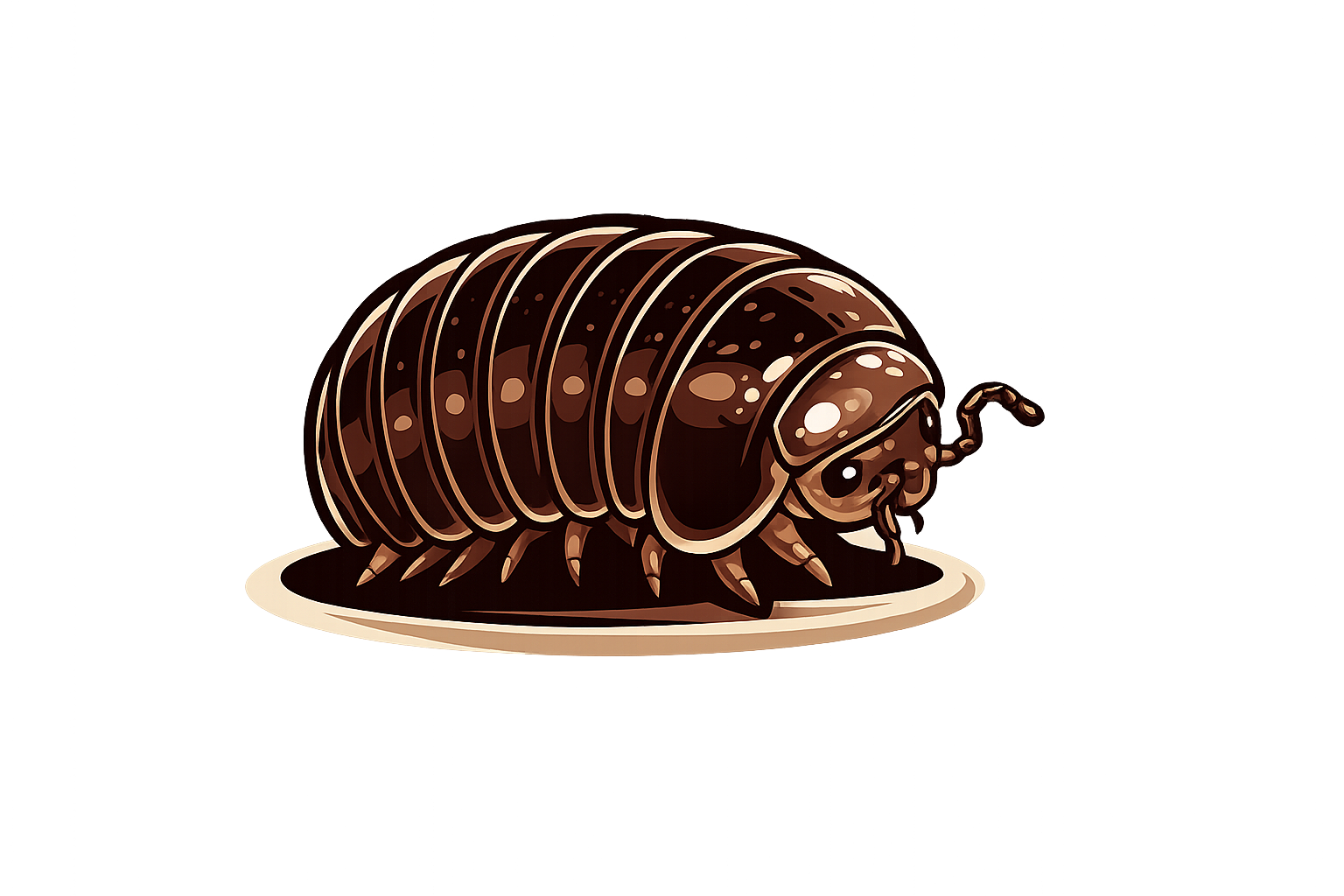
Superorder · Diplopoda · Pentazonia · Chilognatha
CLICK TO ROLL

Superorder
Oniscomorpha

The living armored spheres — ancient architects of the forest floor

0 Described Species
0 Orders (inc. fossil)
0 Million Yrs of Evolution
0 % Define Conglobation
Scroll

Systematics &
Evolutionary Architecture

Placed within Diplopoda → Chilognatha → Pentazonia, Oniscomorpha is defined by several key synapomorphies absent from all other millipede lineages. The group's most famous trait — conglobation, or perfect volvation into a sphere — is the evolutionary north star around which every other anatomical feature is organized.

The name derives from a striking convergence: Oniscomorpha millipedes superficially resemble terrestrial isopod crustaceans (woodlice, Oniscidea), yet arrived at this body plan entirely independently — one of the animal kingdom's most celebrated examples of convergent evolution.

Oniscomorpha SUPERORDER †Amynilyspedida EXTINCT · CARBONIFEROUS–PERMIAN Glomerida HOLARCTIC · ~450 SPECIES Sphaerotheriida GONDWANAN · ~350 SPECIES 305 MYA CARB.

Key Synapomorphies of Oniscomorpha

🔵
Divided Sternites

The ventral sternal plates are split medially — a defining character absent in all Helminthomorpha (other millipedes).

🦷
Single Median Labral Tooth

The labrum (lip structure) bears a single median tooth — a morphological synapomorphy unique to the superorder.

🛡
Enlarged Thoracic Shield

The 2nd tergite (collum) is massively enlarged into a thoracic shield that forms the rim of the rolled sphere.

🔒
Massively Enlarged Pygidium

The terminal anal shield is greatly expanded and acts as the "cap" of the sphere — tightly sealing when conglobated.

🦵
Telopods for Reproduction

Unlike all other millipedes (which use 7th-segment gonopods), male oniscomorphs use modified terminal telopods for sperm transfer.

🌍
Obligate Terrestriality

All oniscomorphs are exclusively terrestrial detritivores — deeply integrated into humid forest-floor nutrient cycles.

The Three Orders

† Extinct

Amynilyspedida

Middle Pennsylvanian → Permian

The earliest known radiation of pill millipedes, preserved in Carboniferous coal-swamp Lagerstätten. Possessed spiny tergites, large compound eyes, and 14–15 body segments — more than their surviving relatives. Went extinct before the Mesozoic.

14Segments
305MYA Origin
30mm Max
Extant · North

Glomerida

Holarctic · ~450 Species

The smaller northern order, distributed across Europe, North Africa, Southeast Asia, and the Americas. Chemically armed with toxic quinazolinone alkaloids (glomerin, homoglomerin) secreted from dorsal ozopores. 11–12 tergites; single-row ocelli.

450Species
20mm Max
12Tergites
Extant · South

Sphaerotheriida

Gondwanan · ~350 Species

Giant pill millipedes of the southern hemisphere, strictly Gondwanan in distribution. No chemical defense — instead relying entirely on a heavily calcified cuticle with mechanical locking carinae. The largest reach baseball size in Madagascar.

350Species
100mm Max
13Tergites

Global Distribution
& Biogeography

The two living orders divide the globe along the ancient Pangean fracture: Glomerida in the north (Holarctic), Sphaerotheriida in the south (Gondwanan). The extinct †Amynilyspedida is known from Carboniferous fossil sites in Euramerica.

The Three Orders

  • GlomeridaHolarctic
    Northern pill millipedes distributed across Europe, North Africa, the Caucasus, Southeast Asia, and the Americas. ~450 species in 4 families. Chemically armed with quinazolinone alkaloids.
  • SphaerotheriidaGondwanan
    Giant pill millipedes of the southern hemisphere — southern Africa, Madagascar, India, SE Asia, and Australasia. ~350 species in 5 families. Mechanically armored with calcified cuticle.
  • †AmynilyspedidaFossil · Euramerica
    Extinct order known from Carboniferous–Permian fossil sites in Illinois (Mazon Creek) and France (Montceau-les-Mines). Spiny tergites, large compound eyes, 14–15 body segments.

Global Distribution of Oniscomorpha

Glomerida
Sphaerotheriida
†Amynilyspedida (fossil)

†Amynilyspedida
& The Fossil Record

The superorder Oniscomorpha has roots deep in the Carboniferous — over 305 million years ago. The extinct order †Amynilyspedida represents the earliest diversification of pill millipedes, preserved in exquisite detail in the coal-swamp Lagerstätten of Euramerica.

🪨 Mazon Creek & Montceau-les-Mines

The finest specimens come from two world-class Carboniferous deposits: the Mazon Creek ironstone nodules of Illinois, USA (Pennsylvanian, ~307 Ma), and the Montceau-les-Mines Lagerstätte of Burgundy, France (Stephanian). Both preserve soft tissue details with remarkable fidelity.

🦕 Key Genera

Amynilyspes — the type genus; includes A. wortheni and A. crescens, reaching 30 mm. Bore prominent dorsal spines and large compound eyes, suggesting active surface-dwelling in Carboniferous forests.

Additional genera include Glomeropsis, Archiscudderia, and Palaeosphaeridium.

🔬 What Made Them Different

†Amynilyspedida had 14–15 body segments — more than either modern order (11–13). This suggests the evolutionary trajectory of Oniscomorpha consistently favored segment reduction and fusion to perfect the spherical volvation mechanism over hundreds of millions of years.

Their prominent dorsal spines and larger compound eyes differentiate them sharply from modern forms, whose carapaces are smooth and whose eyes are reduced.

Geological Timeline

Carboniferous
359–299 Ma
★ Origin of †Amynilyspedida (~305 Ma)
Permian
299–252 Ma
†Amynilyspedida extinction
Triassic
252–201 Ma
Pangea begins fragmenting
Jurassic
201–145 Ma
★ Glomerida / Sphaerotheriida diverge
Cretaceous
145–66 Ma
Gondwana rifting shapes Sphaerotheriida ranges
Today
0 Ma
★ 800+ living species worldwide

"†Amynilyspedida crept through Carboniferous coal swamps over 300 million years ago — spiky, large-eyed, and already rolling into spheres long before the first dinosaur walked the Earth."

The Living Orders
& A Tale of Two Hemispheres

The two surviving lineages divide the globe almost perfectly along the ancient Pangean fracture: Glomerida in the north (Holarctic), Sphaerotheriida in the south (Gondwanan). Despite both being capable of perfect conglobation, their anatomies, defense strategies, and reproductive behaviors diverged dramatically.

Glomerida

Holarctic · ~450 Species · 5 Families

The smaller of the two extant orders, Glomerida are distributed across Europe, North Africa, Southeast Asia, and parts of the Americas. They rarely exceed 20 mm and are the only oniscomorphs with functional repugnatorial glands — producing some of the most potent defensive alkaloids known in arthropods.

Their eyes, where present, consist of a single row of simple ocelli, distinguishing them clearly from Sphaerotheriida's large compound eyes. They possess 11–12 tergites.

  • 11–12 tergites (fewer than extinct ancestors)
  • Single-row ocelli where eyes present
  • Functional dorsal ozopores — unique among Oniscomorpha
  • Glomerin & homoglomerin — quinazolinone sedative alkaloids
  • Up to 20 mm body length
  • Key families: Glomeridae, Protoglomeridae, Doderiidae

The flagship European species, Glomeris marginata, is among the most studied pill millipedes in the world — and the primary source of our understanding of glomerin biochemistry.

⚗️
Dorsal Ozopores
Gland openings run along the dorsal midline — a unique position vs. lateral ozopores in other millipede orders. Each secretes a toxic quinazolinone fluid when threatened.
Chemical Defense
💊
Glomerin Alkaloids
A powerful sedative and paralytic agent against spiders, ants, and birds. Glomerin and homoglomerin are quinazolinone compounds — structurally related to Quaalude (methaqualone).
Biochemistry
👁
Simple Ocelli
When present, eyes consist of a single row of ocelli — simple photoreceptors — rather than the large, faceted compound eyes of Sphaerotheriida.
Sensory
🌍
Holarctic Range
Widespread across the Northern Hemisphere — one of the broadest distributions of any millipede group, reflecting dispersal across once-contiguous Laurasian landmasses.
Biogeography

Sphaerotheriida

Gondwanan · ~350 Species · 5 Families

The giants of the superorder. Strictly Gondwanan in distribution — found in southern Africa, Madagascar, southern India, Southeast Asia, and Australasia — their range is a living map of tectonic history. They possess exactly 13 body segments and have abandoned chemical defense entirely.

The most extreme example of island gigantism in the order occurs in Madagascar, where Zoosphaerium reaches baseball size (up to 10 cm). Their large kidney-shaped compound eyes contrast sharply with Glomerida's simple ocelli.

  • Exactly 13 tergites — fixed across the order
  • Large compound eyes — kidney-shaped, highly developed
  • Zero ozopores — complete abandonment of chemical defense
  • Locking carinae — sclerotized ridges creating mechanical seal
  • Up to 100 mm (Zoosphaerium, Madagascar)
  • Key families: Sphaerotheriidae, Arthrosphaeridae, Zephroniidae, Cyliosomatidae, Procyliosomatidae

The Five Families

  • ProcyliosomatidaeAustralia · NZ
    The most basal family, resolved as the sister group to all other Sphaerotheriida. Strictly endemic to Australia and New Zealand, representing the deepest split in the order's phylogenetic tree.
  • CyliosomatidaeAustralia
    Found across Australia alongside the more basal Procyliosomatidae. Shares the ancient Australian continent with its phylogenetic relatives, reflecting Gondwanan origins.
  • ZephroniidaeSE Asia · Himalayas
    The only family extending into the Northern Hemisphere. Distributed from the Himalayan foothills to the Philippines and Sulawesi — the result of the Indian subcontinent's collision with Laurasia carrying ancestral lineages northward.
  • SphaerotheriidaeSouthern Africa
    Endemic to southern Africa, primarily South Africa with isolated populations in Zimbabwe and Malawi. Robust, heavily calcified exoskeletons — the most mechanically formidable in the order.
  • ArthrosphaeridaeIndia · Madagascar
    A monophyletic clade bridging southern India and Madagascar — reflecting the ancient direct land connection before rifting. Includes spectacular island gigantism (Zoosphaerium, up to 100 mm) and localized island dwarfism (Microsphaerotherium).
🛡
13 Tergite Plates
Collum + thoracic shield + 10 body tergites + anal shield. The cuticle is heavily calcified — near-ceramic hardness, impregnated with calcium salts.
Exoskeleton
🔒
Locking Carinae
Sclerotized ridges on the underside of tergites snap over a brim on the thoracic shield, creating an unyielding physical seal impervious to crush-force and desiccation.
Biomechanics
👁
Compound Eyes
Large, highly developed kidney-shaped compound eyes — a dramatic contrast to Glomerida's simple ocelli rows. Suggests a visual ecology more dependent on light/movement detection.
Sensory
📐
Island Gigantism
Malagasy genera like Zoosphaerium demonstrate extreme island gigantism — reaching the size of a baseball (≤100 mm). Isolated island populations routinely produce extreme size variation.
Evolution

Defense Strategies
& The Divergence

The two living orders arrived at a striking evolutionary fork: Glomerida invested in a chemical arsenal of potent alkaloids, while Sphaerotheriida abandoned chemistry entirely and bet everything on mechanical impenetrability. Both strategies succeed — but the mechanisms are polar opposites.

Chemical Defense

Glomerida · Quinazolinone Alkaloids

Glomeridans possess functional dorsal ozopores — repugnatorial gland openings along the dorsal midline. When threatened, they secrete a clear, odorless fluid that immobilizes predators through pharmacological action rather than physical force.

The active compounds — glomerin and homoglomerin — are quinazolinone alkaloids with sedative and paralytic properties potent enough to incapacitate spiders, ants, and small vertebrates within minutes. Structurally, these molecules are related to the synthetic drug methaqualone.

Glomerida OnlyQuinazolinonesSedative / Paralytic

Simulated ozopore secretion response curve on predator contact

Mechanical Defense

Sphaerotheriida · Calcified Armor

Sphaerotheriida completely abandoned repugnatorial chemistry. Instead, they evolved the heaviest, most calcified cuticle in Diplopoda — a near-ceramic shell reinforced by calcium salts and locking via precisely machined carinae ridges.

When conglobated, locking carinae on the inner tergite faces snap over the brim of the thoracic shield, creating an unyielding seal. The resulting sphere withstands crushing forces far beyond those of most predators. Growth rings on the cuticle reveal lifespans exceeding a decade.

Sphaerotheriida OnlyCalcified CuticleLocking Carinae
LOCKING CARINAE — CROSS SECTION TERGITE SHIELD BRIM

Tergite carinae ridge interlocking with thoracic shield brim

Biomechanics of
Volvation

Conglobation is the defining act of Oniscomorpha — the ability to roll into a perfect, sealed sphere in under a second. While both living orders share this capability, the micro-anatomy of their locking mechanisms reflects their independent evolutionary refinements of the same inherited body plan.

Extended — At Rest

The animal moves normally, legs in metachronal waves, antennae sampling the environment. The massive anal shield trails behind; the thoracic shield protects the anterior.

Threat Detected — Beginning Curl

On threat detection, longitudinal muscles contract simultaneously. The body flexes ventrally; the head tucks inward; legs retract toward the midline.

Half-Enrolled

The posterior curls forward and upward. The anal shield rotates on its hinge toward the thoracic shield. Legs are fully hidden. The tergite margins begin interlocking.

Locked Sphere ✓

Carinae engage with a tactile click. The sphere is complete — impervious to most predatory force. In Sphaerotheriida, this seal is nearly airtight, also reducing desiccation.

EXTENDED BEGINNING CURL HALF ENROLLED LOCKED SPHERE ✓ Carinae engaged

Ecology &
Forest Role

🍂 Keystone Detritivores

All oniscomorphs are macroscopic detritivores, feeding on decaying leaf litter and dead wood. Specialized hindgut microbiota — analogous to termite communities — enables digestion of lignin and cellulose that most animals cannot process.

0mg/day fecal output
10+yr estimated lifespan

🌱 Calcium Cycling

Oniscomorphs require enormous calcium inputs for their calcified exoskeletons — making them vital agents of calcium cycling in old-growth forest and karst-limestone ecosystems. Their selective grazing on calcium-rich substrates concentrates and redistributes this scarce nutrient.

Ca²⁺Calcium cycling vector
Karst specialists

🍄 Mycorrhizal Dispersal

With defecation rates of 350–470 mg per individual per day, these millipedes are significant humification engines. Their fecal castings physically fragment litter and disperse mycorrhizal fungal spores — accelerating soil formation and fungal network expansion across forest habitats.

🌳 Micro-Habitat Specialists

Most species are obligate humidity specialists, confined to specific microhabitats. Select Malagasy species (Zoosphaerium arborealis) have adopted an arboreal lifestyle in humid rainforests. Fascinatingly, in arboreal species, the rolling reflex is behaviourally suppressed — rolling at height would mean a fatal fall.

🔬 Biogeographic Sentinels

Sphaerotheriida's strict fidelity to Gondwanan vicariance makes them ideal bioindicators of ancient forest continuity. Their presence signals intact, undisturbed primary forest — and their absence from a site signals ecosystem degradation.

🐛 Metachronal Movement

Locomotion proceeds via a slow, elegant metachronal wave — a sequential stepping pattern rippling from posterior to anterior. Hundreds of legs move in flowing coordination. Molting during dry seasons requires weeks of complete immobility, during which the animal remains conglobated.

Reproductive Biology
& Stridulation

Reproduction across Oniscomorpha involves complex behavioral rituals to overcome the female's default defensive posture — rolling into an impenetrable ball. The two living orders evolved strikingly different solutions to this fundamental problem.

Glomerida rely on chemical pheromone signaling and gentle palpation to persuade females to unroll. Sphaerotheriida evolved a more dramatic acoustic solution: the males literally sing females into unrolling by vibrating stridulatory organs against the sealed sphere.

🎵 The Harp & Washboard (Sphaerotheriida)

Males possess a stridulatory organ on their anterior telopods — a harp of sclerotized ribs that rubs against knobs on the anal shield. Females have complementary ridges on their subanal plate, the washboard. The resulting vibrations are species-specific — acting as a frequency-coded lock that only the correct male can open.

Simulated species-specific vibrational signal

Mating Sequence (Sphaerotheriida)

Female Conglobates

Any approach causes the female to roll into a locked sphere. The male must work around this impenetrable reflex defense before mating can begin.

Male Stridulates

The male approaches and rubs his harp against anal shield knobs, transmitting species-specific vibrational frequencies directly through the substrate — ground-bone-sphere conduction.

Female Recognition

Upon recognizing the correct species-specific signal, the female uncoils — an act of consent encoded in vibrational frequency. Non-conspecific signals are ignored.

Posterior Telopods Engage

The male's modified posterior telopods — unique to Oniscomorpha — firmly clasp the female's first legs, securing their reproductive position.

Spermatophore Transfer

A spermatophore is ejected from penes located behind the 2nd leg pair and passed backward by legs to the female's vulvae — an elaborate multi-step indirect transfer unique to this superorder.

Conservation &
Vulnerability

Despite their impenetrable armor, oniscomorphs are deeply fragile in the face of anthropogenic change. Their slow reproduction, micro-endemism, dispersal poverty, and strict habitat requirements make the entire superorder highly susceptible to habitat disruption and climate change.

🌲
Deforestation
Slash-and-burn agriculture and logging destroy moist forest habitats both orders depend upon. In Madagascar, many Sphaerotheriida species persist only in rapidly shrinking fragments.
💊
Traditional Medicine Trade
In southern Africa, significant collection pressure from traditional medicine trade targets Sphaerotheriida. Their large, impressive size makes them conspicuous and easily over-harvested.
🏔
Micro-Endemism
Poor dispersal abilities and strict humidity requirements confine many species to single karstic hills or forest fragments. Local extinction is effectively permanent — there is no recolonization pathway.
🌡
Climate Sensitivity
As obligate humidity specialists, even modest changes in rainfall patterns can extirpate isolated populations. Their inability to disperse means suitable climate refugia must exist within existing tiny ranges.
🔬
Taxonomic Discovery Potential
Hundreds of species likely remain undescribed — particularly in Glomerida (SE Asia) and Sphaerotheriida (Madagascar, SE Asia). Some may already be endangered before receiving a formal name.
⚗️
Biochemical Value
Glomeridans' glomerin alkaloids represent an untapped pharmacological resource. Related compounds have sedative and antiparasitic properties — suggesting unexplored medicinal applications.

"Despite their armored appearance, these ancient arthropods are among the most vulnerable denizens of the world's threatened forests — slow-reproducing, highly localized, utterly dependent on the humid, complex habitats that humans are destroying fastest."